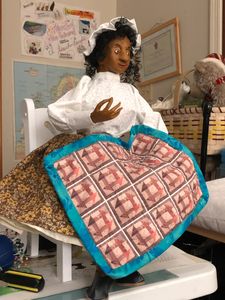
When a slave owner was pursuing a runaway slave and lost sight of him, he claimed that the slave had vanished on the "Underground Railroad." Thus, the concept of the Underground Railroad as a passage to freedom for escaped slaves emerged. Rather than a physical track or designated route, the Underground Railroad was a network of abolitionists and safe houses that assisted slaves in escaping from southern plantations to the north, particularly Ohio and Canada. The safe houses along the way were known as "Stations," those who guided the escapees were called "Conductors," and the runaways were referred to as "Passengers."
One of the most critical components of the Underground Railroad was secrecy. During the 20th century, stories surfaced about African American quilts used during the mid-1800s. Historians debate the validity of the idea that these quilts contained encoded messages. Some researchers suggest that the quilts were displayed on clotheslines or fences in plain sight of both slaves and slave owners, with messages concealed from everyone except those who understood the code. At least fourteen different patterns, utilizing various combinations of geometric shapes, abstract designs, bold colors, and stitches, were employed in the secret quilt codes, many of which are still utilized by modern quilters today. See the sampler pictured above.
My presentation includes a display of the blocks of the Underground Railroad Quilt Codes, which were part of the oral history shared by Ozella McDaniel Williams*, a descendant of slaves, with the authors of the book, Hidden in Plain View. Ms. McDaniel’s narratives support the accounts passed down by our ancestors and emphasize the significance of kinship and oral history that have been preserved within families for generations. Additionally, these stories highlight the role that quilting workshops play in preserving African American history and culture.
*Tobin, Jacqueline I. & Raymond G. Dobard, PH.D.
Hidden in Plain View: A Secret Story of
Quilts and the Underground Railroad.
Anchor Books, New York, NY. 1999.